Large selection Unique brands Nice prices


« Back to Tips & Guides
Guide for Horse Rugs

On this page we go over what rugs you can use for your horse in different situations. Here you will find information on how to measure your horse to choose the right size, how to try on the rug, what types of rugs are available, rug accessories and how to best wash your rugs. We start with the rug size - how do you choose the right size of rug for your horse or pony?
Choosing the right size - measure like this!
When you buy a rug for your horse you choose the size according to the back length of the horse. You measure the length from the withers to the tail. Below you will find a chart of common sizes based on the horse's back length, but keep in mind that this is approximate and differences between individuals exist - and besides, the rug sizes sometimes differ between different manufacturers. The best way to find the right size is to measure the back length, find the nearest rug size, and try on the rug. More about this further down.

Some manufacturers, such as QHP, use other size charts. Instead, in the rugs from QHP, you choose rug size according to the total length of the rug (not the horse) - hence many of the sizes sound big. Here you will find a PDF for what sizes these correspond to in "regular" rug sizes.
Different manufacturers - different sizes?
As with clothing (for people ☺), the sizes of the horse rugs can differ between different brands and manufacturers. An example is Bucas which has in-between sizes such as 130 cm, 140 cm, 150 cm and so on. This can be great if you have a horse that is between two sizes. But even when you try two rugs of the same size, say 135 cm, from two different manufacturers, the fit can differ slightly. One of the rugs may be wider at the front, while the other may be too narrow at the front. Or it doesn't sit quite right over the back and rump of the horse. The tip we can give regarding the fit is to try out the new rug with a thin (clean) blanket or sheet underneath to see if it fits well. After a while if you have tried different rugs from different brands you can start to get an idea of how they usually fit your horse. Usually, each manufacturer has a certain design they use when making their rugs, and hence the same size usually has about the same fit in the manufacturer's different models. If you have two horses with the same rug size, the same rug can fit different on the different horses because their bodies can look different - size of withers, back and rump design, distance between withers and chest and so on may differ.
How should the rug fit?
A horse rug should fit so that it rests against the shoulders, it should not fit too loose. You should be able to fasten the rug in the front and under the belly without any problem and it should go up over the withers. The leg straps and cross-surcingles should not be so loose that the horse can get stuck with the legs. A rug that fits well will sit in place on the horse without sliding forward, back or to the side when the horse has been wearing it for a few hours. A loose-fitting rug compared to a well-fitted rug can mean the difference between whether your horse gets chafed or not. An oversized rug does not move with the horse in the same way and the friction when the rug moves can cause the horse to get rubs. Also, be sure to take good care of your rugs and if a rug is broken - do not let the horse continue to wear it before it is repaired. A large hole in the rug or a loosened buckle that hangs can be a safety hazard.
Smart rug accessories for a better fit
There are a variety of accessories for horse rugs that you can use to improve the fit or prevent chafing. An example is a chest extension, sometimes called a shoulder extension. With a chest extension you can create more space at the shoulders and hence the rug is extended / enlarged between the withers and the shoulders. This is a great accessory if you have a horse that is very wide at the front, or if you have a rug that fits well on the horse but is a little too tight at the front.
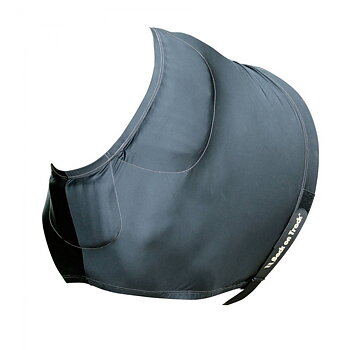
Shoulder guard is another rug accessory that can be used especially on horses that are clipped. The shoulder guard sits as a thin and flexible barrier between the seams of the rug and the horse's body, thus preventing chafing. Shoulder guards are often made of a stretchy material with as few seams as possible, pulled over the head of the horse and fastened behind the front legs. There are also models of shoulder guards that instead have Velcro straps or zippers.
A loose neck part is an accessory that can be used at different times. It may be to further protect the horse from rain, cold or flies. Just what it sounds like, the neck part is attached to the horse's rug and protects the horse's neck. Loose necks are available with different properties and fillings to match different rugs. Some have buckles or elastic bands which are put as a browband or fastened in the horse's halter to hold the neck part in place. Here at Petster you will also find practical loose neck parts for horses with eczema that can be used on their own without a rug. These loose equine eczema neck parts can also be used if the horse has a wound on the neck that you want to protect against flies and dirt. They are easily put on over the head and snapped behind the front legs.
Fly hood or fly mask is a horse accessory that you can use to supplement a fly rug. In a way you can count it as a rug accessory. But a fly hood can also be used on it's own. Fly masks are available in many different designs and materials. They protect the horse's eyes and face from irritating flies and flying insects. Some fly hoods have cutouts for the ears so that the horse's ears are "free", others also cover the ears and then provide insect protection to the horse's ears as well.
How to put on the rug
When you are to put a rug on the horse, you always start from the front. When you put the rug over the horse, you first fasten the front buckles, then the surcingles under the belly and lastly the leg straps and tail string. This is the safest way to put a horse rug on the horse. When taking the rug off, do the opposite. Then you start from the back with the tail string and leg straps first then the surcingles and finally the front buckles.
How thick should the rug be?
This is highly individual and difficult to answer. But there is a very modern and smart gadget that you can use to get help deciding this - a sensor. Here at Petster you will find Orscana Chip which is a rug sensor you attach to the horse's rug. This can measure the horse's temperature and humidity level below the rug, so that you can more easily determine which rug the horse should have in different weather conditions and outside temperatures.
Different types of horse rugs
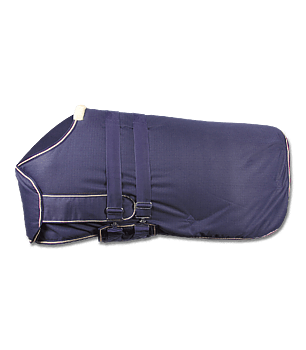
Turnout rugs is a term for rugs that the horse wears when it is in the pasture. It is a fairly broad term that can include both rain rugs and winter rugs - any outdoor rug. A turnout rug can be without filling or have several hundred grams of filling.
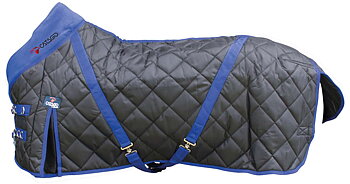
Winter rugs are a warmer and thicker type of rug that the horse can wear during the colder season. Winter rugs can be filled with anywhere from 100 grams to 700 grams or more - depending on what your horse needs. It goes without saying that a rug with more filling is warmer than a rug with less filling. Winter rugs should help the horse keep its body temperature in the cold without too much effort, while also providing protection against moisture from snow and rain. The rugs should be breatheable so that the horse can stay dry and so that moisture is carried away from the horse's body.
Rain rugs are with or without filling and they provides protection against rain. The rain rug is made of materials that are water resistant and sometimes even impregnated to keep the horse dry for as long as possible. Rain rugs can have 0 grams of filling or a few hundred grams. It is important that a rain rug breathes and is permeable to moisture from the inside so that the horse does not get wet from the inside.
Stable rugs is a type of rug that is intended to be used when the horse is inside the stable or stall. The rugs are made of other materials compared to the turnout rugs as they do not have to withstand rain or moisture from the outside. A stable blanket / rug can keep the horse warm when it is in its stall, or when trailering the horse. These rugs are available with more and less filling so you can adjust the thickness of the rug to the temperature and whether your horse is clipped or not.
Sweat rugs can be used after training when the horse is sweating or as a moisture-absorbing rug after you shower the horse. The sweat rug is made to carry moisture away from the horse's body and it does this by absorbing the moisture to the outside of the rug so that the moisture can evaporate. Cooling rugs are another type of rug that has a similar function, which is often made in a mesh material to keep the horse cool.
Fleece rugs can be used as thin stable blanket, sweat rug or trailer rug. Fleece blankets tend to be simply designed with cross-surcingles, front buckle (one or more) and tail string. Some models have neck part and leg straps, other models are missing surcingles under the belly. The fleece rugs without surcingles under the belly are often made to sit on the horse for a short time, for example after showering, and can be supplemented with a loose elastic rug surcingle if you wish.
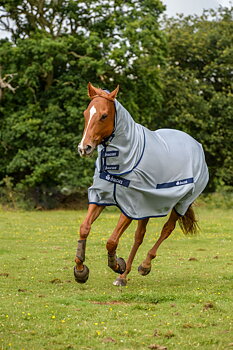
Fly rugs protects the horse from flying insects. Some fly rugs protect the horse's entire body with the exception of legs and head, and have a neck part and belly plate. Other fly rugs also have built-in fly masks to protect the horse's eyes, ears and face. There are also lighter variants of fly rugs that are mesh rugs with regular cross-surcingles (without belly plate). Some fly rugs have zebra pattern, which according to studies can make a fly rug effective because it confuses flies and insects so that they have a harder time to land on the horse.
Eczema rugs provides protection against insects whose stings and saliva can give some sensitive horses skin symptoms in the form of itchy equine eczema. Eczema rugs tend to be fairly tight-fitting and protect large parts of the horse's body - often with a belly plate and neck part. Sometimes even with a hood to protect the head, face and ears.
Riding rug / Quarter sheet is a rug that warms the muscles of the horse's back and rump during the riding session and / or protects against rain. It can be designed in several ways. Quarter sheets are usually fastened in the saddle straps and protect the loins and quarter. The riding rug can instead be fastened in front of the saddle, and have a cutout for the saddle. Some riding rugs have a neck part and then they often have front buckles, cover a larger part of the horse and have a cutout for the saddle too. You can have the riding or quarter sheet on the entire riding session, or take it off when the horse is has warmed up.
Foal rugs are just as it sounds like rugs for foals. These are small sized rugs that are designed to fit the foal's body and protect against rain and / or cold. The rugs are available with and without filling.
Reflective rugs has reflective details that makes your horse more visible in the dark and in poor visibility. There are reflective rugs that the horse can wear in the pasture, and riding rugs with reflective details. Sometimes the rug has an reflective edge or details in reflective material, and sometimes it is also made in a bright color that has good visibility in the dark. A reflective riding rug can make the ride safer when it is dark outside or when visibility is poor.
Therapy rugs or therapeutic rugs are special rugs with certain properties. Therapeutic rugs can have a warming or cooling effect, be magneticor have other functions for rehabilitating the horse.
Combi rugs is a collective name for different types of hybrid and combined rugs. A combi rug can combine two or more functions in one and the same rug. Some examples are fly riding rugs and fly-rain-rugs. A fly rain rug often has a certain material over the back to protect against rain, and another material at the bottom to protect against flies.
To wash a horse rug
Horse rugs are most easily washed in a larger washing machine. If you only wash one rug at a time (which is not too heavy for the machine), it can be washed in a regular washing machine. Make sure to use a big laundry bag to reduce the amount of horsehair stuck in the washing machine. The thing to keep in mind when washing the rugs is to attach all the buckles and tie up long straps and surcingles. Try brushing a blanket with a brush on the inside before putting it into the machine if it is full of horsehair, and brush away mud from the outside. You can also rinse the rug with a hose outdoors first, to remove the worst dirt. It is common to wash at max 40ºC, but it can differ between different rugs - always check the washing instructions and follow these.
Turnout rugs should not be washed too often, so if the rug is not too dirty, you can quickly rinse or brush the rug instead. If the rug is broken, do not wash it in the machine, as tears and broken straps can extend the rug's damage or even get stuck in the washing machine. Use a horse rug detergent for best results and avoid softeners. The rugs should then be hung dry until completely dry. If it is a rain rug or winter rug, you can impregnate the blanket when it is dry. A laundry bag and washing balls can be used to reduce the amount of horse hair remaining in the washing machine. These attract loose fur so that your next load of laundry does not get covered in fur. It can be good to run a self-cleaning / machine-cleaning program after you wash the horse rug in your regular machine so that the machine is cleaned before washing ordinary clothes and textiles. If you do not have access to a washing machine, the horse rugs can be rinsed or hand washed in a bathtub.