Large selection Unique brands Nice prices


Feeding Guide for Horses
Choosing feed for your horse can be very simple - or really complicated. On this page we will guide you on how to choose the right feed type for your horse, how to make a balanced feed chart and advice on feeding.
Calculating feed charts
When calculating how much feed the horse should eat each day, you need to look at a few different factors. These factors are:
♦ Age of the horse
♦ Gender (Mare / Gelding / Stallion)
♦ Weight
♦ Body condition score (Skinny / Normal / Fat)
♦ If the horse is an easy-keeper / normal / hard-keeper
♦ Level of activity
You probably already know some of these factors, others you may need to find out. If you do not know the weight of the horse or how it´s body condition is, you can find out from your veterinarian, or figure it out yourself. With the help of a weight measuring tape you can measure roughly what your horse weighs. Then you quickly get an idea of what your horse weighs - this is not as accurate as a scale. There are also formulas that you can use where you measure different body measurements to calculate weight (see page 35 in this pdf from SLU).
To get an idea of what the horse´s body condition score is, you can check and feel the horse with the help of a body condition assessment chart. You will find a good such chart at the Swedish University of Agricultural Sciences where it can also be printed in pdf format. If you find it difficult to assess yourself, you can take help from someone who is experienced, or ask your veterinarian.
With the above factors you can use a simple mathematical formula (see below) to get your horse's maintenance need. This is the need for energy the horse needs to meet its basic needs such as breathing, standing, eating, peeing, pooping and maintaining its weight (not gaining weight or losing weight). In addition to this, you need to find out if you have a horse that is normal, an easy-keeper or hard-keeper (also known as good dooer, poor dooer) as well as take info account any work or activity the horse performs. If you have a stallion, you should also make another addition to the maintenance need which is + 10%.
Do you know if your horse is an easy-keeper, normal or a hard-keeper? And what does it mean? When calculating the horse's energy and nutritional needs, it can be divided into these three categories. For easy-keeper horses, ponies and cold blood breeds are usually included. If the horse is an easy-keeper, it means that it needs less feed than the average to keep it's body condition and weight. Easy-keep horses and ponies need about 5 percent less energy than a "normal" horse.
Easy-keeper: Pony, coldbloods
Normal (metabolism): Warmbloods
Hard-keeper: Hotbloods, Thoroughbreds
However, one should keep in mind that there are large variations. It differs from individual to individual, so not all coldbloods are necessarily always easy-keepers, just as there may be easy-keep warmbloods, and hard-keep ponies and so on.*
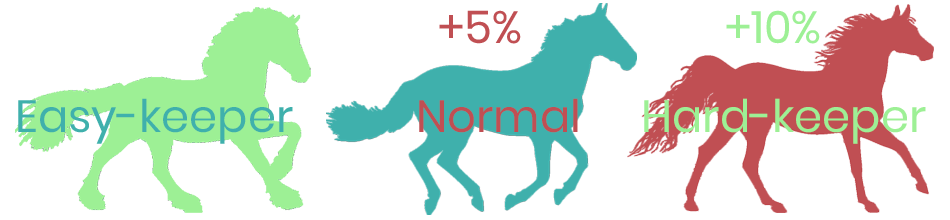
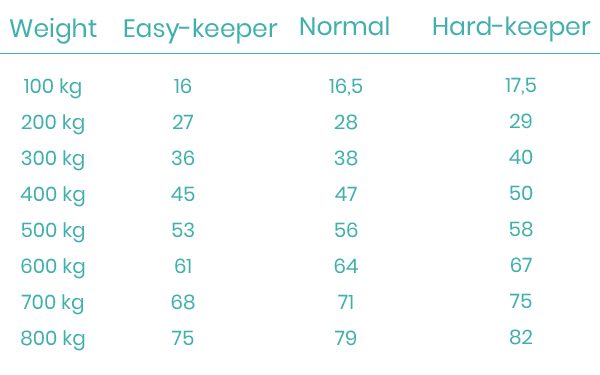
Here is a chart showing the maintenance requirement of energy in millijoules (MJ) per day calculated by body weight. To obtain these figures you use a formula that looks like this for an easy-keeper horse: 0.5 MJ x Bodyweight to the power of 0.75
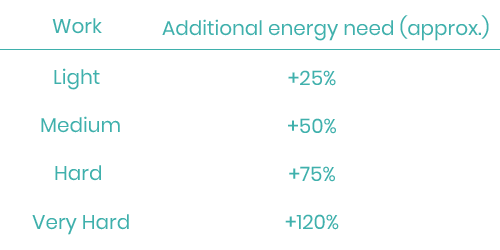
The last factor we take into account in this slightly simpler feeding chart calculation is the horse's level of activity or work. Here you can estimate whether the horse performs light, medium, hard or very hard work. You can also count a little more accurately when you make additions for riding training in the different gaits based on time. Simply put, one can say that a horse does light work with recreational riding, medium work with recreational ride and some training sessions, hard work if it is trained and showed in eventing shows at low or medium level, difficult classes in showjumping or during some race horse training, and very hard work if it is trained for races, competes in enducance or at elite level eventing. This is approximate and general.
Example 1: Mare, 450 kg, 14 years old, medium work, easy-keeper
0.5 MJ x 450 kg to the power of 0.75 = 48.85 MJ - we round to 49 MJ. The maintenance need of the mare is about 49 MJ since she is an easy-keeper. We add +50% of the maintenance need as a addition for medium work -> 49 MJ x 0.5 = 24.5 MJ is the work addition. 49 MJ + 24.5 MJ = 73.5 MJ is then the maintenance need plus the work addition
The horse in example 1 has an energy requirement of about 73.5 MJ / day for maintenance + medium work
Example 2: Stallion, 500 kg, 10 years old, light work, normal metabolism
0.5 MJ x 500 kg = 52.86 - we round to 53 MJ. Add 5% as he has normal metabolism -> 53 x 1.05 = 55.65 MJ. Since it is a stallion, an additional 10% should be added to the maintenance need -> 55.65 MJ x 1.1 = 61.2 MJ. We round to 61 MJ. The stallion's maintenance need is about 61 MJ. For light work we add 25% -> 61 MJ x 0.25 = 15.25 MJ is the work addition. 61 MJ + 15.25 MJ = 76.25 MJ
The horse in example 2 has an energy requirement of about 76 MJ / day for maintenance + light work
Example 3: Gelding, 325 kg, 8 years, hard work, hard-keeper
0.5 MJ x 325 kg = 38.27 MJ - we round to 38 MJ. Addition 10% as he is a hard-keeper -> 38 MJ x 1.1 = 41.8 MJ. We round to 42 MJ. The gelding's maintenance need is about 42 MJ. For hard work we add 75% -> 42 MJ x 0.75 = 31.5 MJ is the work addition. 42 MJ + 31.5 MJ = 73.5 MJ
The horse in example 3 has an energy requirement of about 73.5 MJ / day for maintenance + hard work
If you want to calculate the energy need for work more accuratley you can use these additions:
+ 0.2 MJ / 100 kg and 10 minutes for ridden training in walk
+ 1.3 MJ / 100 kg and 10 minutes for ridden training in trot and canter
Then you calculate the average of ridden work in the different gaits per day and add the figure in MJ you get to the horse's maintenance need.
In addition to energy requirements in MJ, you also need to calculate how much protein, macrominerals, micro minerals, vitamins and water the horse needs. Protein is calculated in grams of digestible crude protein per MJ - which makes it easy to calculate. An adult horse needs 6 grams of digestible crude protein per MJ per day to meet their maintenance need. A growing young horse, foal, pregnant or lactating mares and working horses need the addition of protein that we go through further down in the text.
Protein maintenance requirement -> 6 g x maintenance requirement in MJ
So if we take the same example we used earlier, we can calculate the mare's protein needs (for maintenance):
Example 1: Mare, 73.5 MJ / day -> 6 g x 73.5 MJ = 441 g digestible crude protein
The macrominerals the horse needs are calcium, phosphorus, magnesium, sodium and potassium. Important is the calcium / phosphorus ratio, which should be between 1.2-1.8. See the table below for calculation of macro minerals. This is a minimum requirement (maintenance requirement) in grams per 100 kg of body weight per day.
Again we can use the mare in the example above -> she weighs 450 kg.
Her calcium needs are 4 g x 4.5 = 18 g per day maintenance need.
Phosphorus -> 2.8 g x 4.5 = 12.6 g
Magnesium -> 1.5 g x 4.5 = 6.75 g
Sodium -> 5.1 g x 4.5 = 22.95 g
The calcium - phosphorus ratio then becomes -> 18 g / 12.6 g = 1.42 which is between 1.2 and 1.8 and therefore OK. It is better to be closer to the high than at the low when it comes to this ratio (closer to 1.8 than 1.2). It should not be less than 1.1.
We do not calculate potassium since it occurs naturally in grass feed and roughage in sufficient quantities (in Sweden) - so it does not normally need to be added.
In addition to the maintenance requirement of macro minerals, the work need is added if the horse is young and growing, pregnant or lactating. Here is a chart for approximate work addition for an adult horse:
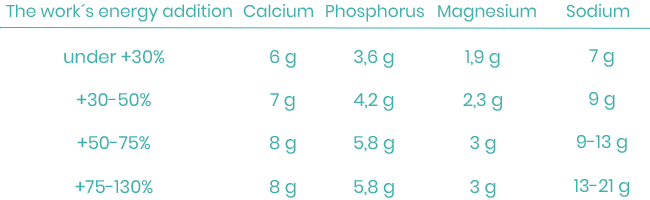
These figures are in grams per 100 kg body weight per day. According to this table we can see that an adult horse doing light work (about +25% energy addition) would have a supplement of about 6 g calcium. This adds to the need for maintenance.
If a 450 kg mare needs 18 g of calcium per day in maintenance need and performs light work, we add 6 g x 4.5 = 27 g for light work. Then her total calcium need per day becomes 18 g + 27 g = 45 g
Micro minerals are the next piece to look at. These are iron, copper, manganese, zinc, cobalt, iodine and selenium. In the table below you can see the approximate need for these in milligrams per day and 100 kg body weight. In principle, selenium always needs to be added in the feed state as Swedish roughage often does not have enough selenium.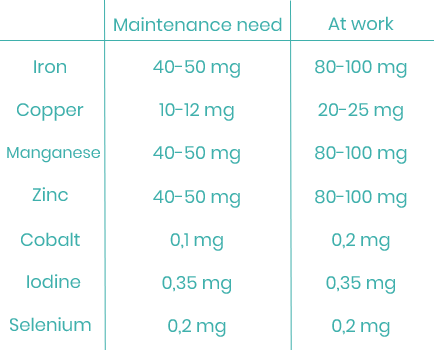
Vitamins are something that may need to be added to the feeding chart of some horses. Here is a chart showing the recommended amount of vitamins for daily supply per 100 kg of body weight, where some vitamins are measured in IU (International Unit) and others in milligrams. If the horse is hard working, growing, lactating or pregnant this table does not apply.
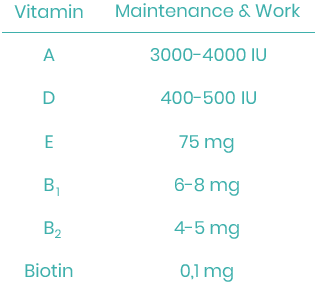
Just as there are limits of minerals and vitamins that should not be fallen short of, so are maximum limits not to be exceeded. It is good that you study properly and do not overfeed with minerals, vitamins and supplements - especially in cases where they are not needed. But how do you find out which minerals you need to add to the horse's feed chart? It's easy - analyze your roughage or forage! ☺
Do you have a growing young horse, a mare that has a foal in her belly, or that gives milke to a foal? Then you need to make further additions to the feeding chart.
A more accurate feeding chart and feeding pregnant or lactating mares
If you want to make a more accurate feed chart and take into account even more factors, you can do a different kind of calculation. In such a calculation, factors are taken into account such as outside temperature, whether the horse stands in a stall or pasture, and whether it is a growing horse or a mare that is pregnant or gives milk. We will not go through all these additions in this guide, but you can find this information in the previously linked pdf from SLU. Here we quickly go through pregnancy and lactation additions.
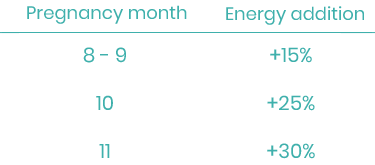
A pregnant mare has an increased need for both energy and protein during pregnancy. It is important that during the last three months of pregnancy, this is supplemented in the feed chart to meet her needs. The protein need is easy to calculate - the addition for the last three months' pregnancy is 12 grams of digestible crude protein per MJ. When calculating the maintenance needs of the pregnant mare, you count her normal weight - not her pregnant weight. The energy addition depends on the month of pregnancy and is calculated as a percentage of the maintenance need in MJ / day. See the table below for energy addition for pregnant mares.
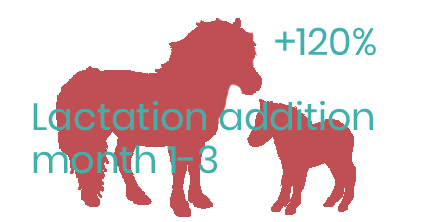
When it comes to lactating mares there is also an increased need for energy and protein. Here, too, the protein addition is 12 grams of digestible crude protein per MJ per day. The feeding chart should be changed only two weeks after foaling, and maintained during these two weeks at the same level as during the late precnancy. Thereafter, one can begin to gradually increase the feed supply according to the new needs. There is a big difference between mares how much milk they produce, but often small pony breeds produce more milk in relation to body weight than a larger mare. The energy addition is calculated based on the month of lactation the mare is in, and adds to % of the maintenance need. The biggest need is from the first to the third lactation month. After the fourth month and until weaning, the need decreases.
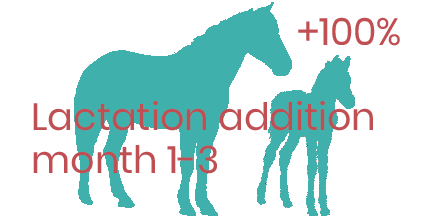
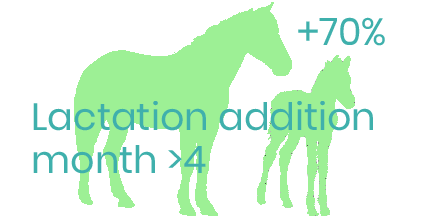
Since smaller mares, such as small pony breeds, produce a lot of milk, they need a larger addition of energy. You usually add about 20% extra in addition to the additions above. So for a small mare, the energy addition can look like this instead:

The horse's need for roughage
There is a simple rule of thumb to calculate how much roughage you should give your horse:
1 kg dm roughage per 100 kg body weight per day
But what does this mean? We work out the concepts. Roughage = the horse's basic food, which should mainly constitute the feed chart. The roughage is the most important part of the horse's diet and you have to make sure that it gets enough of it and that the contents of the roughage cover the horse's needs. Roughage can be hay, haylage, silage, alfalfa and straw. Occasionally, the term forage can be used, and this means that forage is harvested and prepared for use as feed for horses and ruminants, among others.
In order to be able to make smart purchases of roughage / forage suitable for your horse, you need to send the feed on feed analysis. Then you get an answer to what your roughage actually contains and you can calculate the horse's feed chart based on it. The content can differ greatly between different harvests, so make sure you take a new feed analysis every time you buy new forage. In this way, you ensure that your horse gets a well-balanced diet and you reduce the risk of overfeeding with supplements like minerals and vitamins. You also find out if there is a shortage of something in the forage that needs to be added to meet the horse's needs. Sometimes there is a feed analysis already done so that you do not have to send samples of analysis yourself.
Now we come to the next concept - "dm". This stands for dry matter and this is obtained by calculating the water content of the feed. The water is calculated because it contains neither energy nor nutrition. Different roughage types have different water content where silage contains more water than haylage, and haylage contains more water than hay. If a silage has a dm content of 60%, this silage contains 40% water. Four kilos of this silage is then not enough to give a horse of 400 kg according to the above rule, since 40% of the weight is water (4 kg x 0.6 = 2.4 kg dm). Instead, you must give the horse at least 6.8 kg of this silage per day (6.8 kg x 0.6 = 4.08 kg). And observe the words at least - this is the minimum you should give your horse and it is often better to provide more roughage than this for several reasons. Horses, among other things, have a need to chew their feed for a long time and when given the opportunity to do so it reduces the risk of behavioral disorders and colic. If the horse does not have free access to forage, feed at least 2 times a day, and ensure that the horse's longest break from eating is not more than 10-12 hours.
Example: Horse 750 kg. Hay with 85% dm.
1 kg hay = 0.85 kg dm
The horse needs at least 1 kg dm x 7.5 but 7.5 kg of the above hay contains only 7.5 kg x 0.85 = 6.375 kg dm
Giving 8.9 kg x 0.85 = 7.565 kg dm of hay
This horse needs at least 8.9 kg of hay, which is equivalent to 7.565 kg of dry substance hay -> easiest to round up to 9 kg of hay (7.65 kg dm) as it can be easier to weigh with a hay scale ☺
Concentrate and grains
When you have a roughage that cannot meet the horse's need for nutrition, you may need to supplement with concentrate or grains. Concentrate is various mixtures of grains and also soy, alfalfa, oil, flax seed and more. It can be in the form of whole, cut or crushed grains (for example, oats) or in concentrate mixtures in the form of pellets or muesli. Some concentrates are ready-to-use feed that you can feed directly, while other feed - such as beet pulp - needs to be soaked first. Different concentrates have different contents and you can puzzle together a feeding chart by choosing the correct concentrates to supplement your (analyzed) roughage.
Do you have a roughage that does not cover your horse's need for protein? Choose a high protein concentrate feed, like Best Horse Protein Pellets.
You may have a roughage that provides your horse with enough protein - but not enough energy. Then normal-quality pellets or muesli serve as a supplement, such as Best Horse Müsli Classic or Best Horse Basic Pellets.
Is your horse sensitive to oats, or do you need an no-oats feed for other reasons? Then there is Best Horse Müsli Classic Oat-Free which is a concentrate feed alternative without oats.
If you have a horse with a low level of activity that gets everything it needs from its roughage, and who does not need any extra energy or protein, take a look at whether the horse's need for macro and micro minerals is covered by the roughage. In most cases, sufficient levels of selenium, and sometimes other minerals, are missing. Then you can give a mineral feed like Best Horse Mineral Standard in pellet form.
Minerals, vitamins and trace elements - is it necessary?
The short answer is yes. Just as human bodies need a balance of many different trace elements, vitamins and minerals to function optimally, the horse needs to get this too. Vitamin D, for example, is an important vitamin that helps regulate the horse's calcium level in the blood. Zinc is a micro-mineral that the horse needs for carbohydrate and protein metabolism, as well as for keratin formation in hooves, skin, hair and mucous membranes. The macromineral calcium is important for the horse's skeleton and muscles. These are just a few examples of what these minerals and vitamins actually do in the horse's body.
Water requirement
Finally we come to the horse's need for water. This may be the last in this text, but definitely not least - since water is something the horse consumes large quantities of. The horse should always have free access to fresh, clean water - and it is extra important that the horse has water easily accessible in connection with feeding. Often the horse drinks most after feeding. Horses can be really picky when it comes to the taste of the water - you've probably heard at some time that the horse's water should be so clean that you would like to drink it yourself. If the water is of poor quality or the bucket is not washed, it can adversely affect the horse's water intake. So keep it clean in buckets and waterers by washing them out regularly. Many horses prefer to drink from a bucket, and if you have a horse in a stall with an automatic waterer that does not seem to drink enough, you can supplement by hanging a water bucket in the stall. Frozen water in the pastue or paddock in the winter can be remedied with purchased or homemade heated water tanks. If the water is too cold, the horse may not want to drink - which can lead to colic. This also applies to the water you give inside the stall, so you can try giving lukewarm water when the horse comes inside if it has been drinking poorly in the pasture.
The maintenance requirement for water is about 5 liters of water per 100 kg of body weight per day.
If the horse does hard work, the water requirement is between 10-15 liters of water per 100 kg of body weight per day.
If it is a lactating mare, she has a need of around 8-10 liters of water per 100 kg of body weight per day.
Example 1: Mare 9 years old, 350 kg, hard work. 3.5 x 5 liters = 17.5 liters in maintenance requirement, supplement for hard work -> between 17.5-35 liters. This mare has a water requirement (approximately) of between 35-52.5 liters.
Example 2: Mare 11 years old, 500 kg, lactating. 5 x 8 liters = 40 liters to 5 x 10 liters = 50 liters. This mare has a water requirement of about 40-50 liters of water per day.
What can affect the horse's water needs is the temperature and water content of the horse's feed. A horse grazing in a pasture gets more water through the grass (which contains about 70-80% water) than a horse that eats hay with 84% dm content. If it is hot outside and the horse sweats a lot, the need for water can increase as water is lost through sweat.